
This means lower losses on fuel sales by Indian oil companies and a shrinking oil subsidy bill for the government.

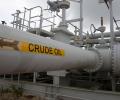
Global crude oil prices slipped below $45 a barrel in early Asian trade on Monday after the Organization of Petroleum Exporting Countries cartel decided not to cut production.

'When we start describing somebody as an enemy that is the start of politics and emotion after which no business can take place.' 'We need to get out of this, allow Indian businessmen to do business with China.'

Both sides have now revealed a preference for escalation over strategic defeat, and each new provocation narrows the space for the next pause. The Touska seizure, Iran's refusal to negotiate under blockade, Israel's strikes on Iranian oil infrastructure -- all of these add up to an increasingly untenable situation. This makes the wild card -- Trump and his motormouth -- more consequential than ever, notes Prem Panicker in his must read blog on the Iran War.

The Congress party has criticised the Indian government's diplomatic efforts, questioning how Pakistan was able to secure a role as a mediator between the US and Iran despite India's attempts to isolate it after the Pahalgam attack. The party also raised concerns about India's standing on the global stage and its relationship with the US and China.

The rupee breached 90-levels against the greenback for the first time on Wednesday, falling 6 paise to 90.02 in early trade, as banks kept buying US dollars at higher levels and FII outflows continued.
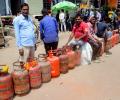
The Indian government has implemented several measures to mitigate external risks, support the balance of payments, and maintain macroeconomic stability amidst the ongoing West Asia crisis, according to Minister of State for Finance Pankaj Chaudhary.

India's electric vehicle (EV) market experienced a significant surge in financial year 2025-26 (FY26), with e4W registrations nearly doubling and e2Ws growing by over 20%, propelled by expanding charging infrastructure, diverse model launches, and accessible financing.

Jewellers in Lucknow protest Prime Minister Modi's appeal to defer gold purchases for a year amid the West Asia crisis, fearing significant business losses and economic hardship for those involved in the trade.

In his first major national address since hostilities began, Trump said the ongoing military campaign, dubbed 'Operation Epic Fury', has delivered 'swift, decisive, overwhelming victories'.

The United States Central Command (CENTCOM) has announced that American forces are maintaining a strict maritime restrictive operation in the region, continuing to enforce a blockade against Iranian ports.

The current trend in crude oil prices gives cause for much concern and if this persists, many of the calculations indicating further recovery and improved growth for the economy can be nullified.

Reserve Bank of India (RBI) Governor Sanjay Malhotra stated that recent regulatory measures to address foreign exchange market volatility, such as capping banks' net open positions, are temporary and aligned with current market conditions, not signalling any structural shift in policy.

Low fuel prices to help oil marketing and refining sectors but upstream players will stay under pressure.

The conflict may disrupt Budget 2026-2027 projections, squeezing revenues and raising subsidies, prompting fiscal adjustments and potential reforms, echoing lessons from the Covid-era shock, points out A K Bhattacharya.

For that to happen America does not have to lose. It only has to do the right thing, asserts Aakar Patel.

The rupee fell 23 paise against the greenback to settle at a new all-time low of 91.01 (provisional) on Tuesday, weighed down by relentless foreign fund outflows, no breakthrough in India-US trade deal, and persistent US dollar buying.

'Our diplomacy should have been focused on preventing war and avoiding the inevitable disruptions it would cause, posing a real risk to India's growth story,' asserts former foreign secretary Shyam Saran.
The Fed's interpretation of the increase in gas prices is the economist's basic mantra of supply and demand.

The intriguing bit is that Trump is likely to attend the talks in Islamabad this weekend -- if he does, it will be the clearest signal yet that the US is ready to exit the war with some sort of win to show, since he cannot afford to go for the talks and return empty-handed, notes Prem Panicker in his must read blog on the Iran War

Alliances fight wars effectively only when they share an endgame. If Israel acted without US knowledge, then the military alliance is operating without real coordination at the level of strategic targeting. Neither picture is reassuring in a war that is no longer regional in its consequences. Prem Panicker continues his must read daily blog on the Gulf War.

India's merchandise exports experienced a slight decrease in February, while imports surged due to increased gold and silver purchases, leading to a widened trade deficit. The West Asia crisis is expected to further impact trade in the coming months.
Government will review fuel pricing scenario in October, Petroleum Secretary M S Srinivasan said on Thursday. The petroleum secretary further said, "Situation will be revisited in October when we will take stock of the scenario emerging out of international oil prices." Global crude prices touched a record $145 a barrel, which is expected to push India's oil import bill this year higher by nearly 76 per cent to $110-120 billion.

By all available indications, the White House drafted a face-saving note and handed it, ready-made, to Islamabad. Pakistani Prime Minister Shehbaz Sharif was supposed to then post it in the guise of a plea urging Trump to extend the deadline by two weeks 'to allow diplomacy to run its course'. Trump would then graciously accept Pakistan's 'request' and declare a ceasefire. Sharif dutifully posted the message on X. Except that he, or whoever was handling the account, forgot to delete the tell-tale first line visible in the edit history: 'Draft - Pakistan's PM Message on X'. Prem Panicker's must read blog on the Iran War.

The dollar devaluation has seen revenue loss incurred by state-run oil firms on fuel sales trimming to about Rs 96 crore per day.

From February to mid-March, oil prices receded rapidly.

Financial year 2025-26 (FY26) saw a significant shift in corporate fundraising, with rights issues more than doubling to a multi-decade high of 51, raising 44,290 crore, while qualified institutional placements (QIPs) more than halved to 29 issues, mobilising 62,954 crore, driven by sharp equity market corrections and regulatory changes.

Reliance Industries' digital arm, Jio Platforms, may see its initial public offering (IPO) delayed to the second half of fiscal 2027, according to CreditSights. The delay is primarily attributed to ongoing geopolitical tensions in the Middle East, which could impact market conditions and investor sentiment.

Amidst rising tensions, Iran threatens to close the Strait of Hormuz to those not adhering to its new regulations, signaling a potential escalation in the region's geopolitical landscape and raising concerns about global oil supply routes.

Karex, the Malaysian company that makes roughly one in five of the world's condoms -- about five billion a year, supplying Durex and Trojan among others -- announced this week that it is raising prices by up to 30 percent. The reason is the Strait of Hormuz.
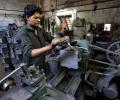
India's manufacturing sector growth slowed to a four-year low in March, impacted by cost pressures, competition, market uncertainty, and the Middle East conflict, according to the HSBC India Manufacturing PMI.

This weekend, Donald Trump has begun to say the quiet part out loud -- that he wants to take control of Iran's oil, a formulation more in line with his robber-baron style of international relations.

'We are profoundly energy-dependent on the Gulf. That dependency must now be redirected towards the United States, because we require American permission to procure oil.' 'We additionally require Iranian permission to acquire oil from that source. So India now has to seek two separate permissions merely to secure its energy supply.' 'Should we be compelled to source from America, or from Venezuela -- which is, in effect, American-controlled supply -- that will inevitably carry a price premium, an elevated shipping cost, and a considerably extended delivery timeline, given the distances involved.'

Trump may strike. He may announce productive talks and extend again. He may do both at the same time. Iran will not open the Strait on someone else's terms, so no matter what happens, that problem will remain unsolved. And the IRGC will still be collecting its $2 million toll from every ship bold enough to ask permission to pass.

Egypt, Pakistan, Saudi Arabia and Turkey met in Islamabad in what analysts say is the formal opening of a new diplomatic formation that could reshape the post-war regional order. Their immediate goal is a ceasefire; their larger ambition is to ensure that neither Iran nor Israel emerges from this war in a dominant position. Pakistan's foreign minister then flew directly to Beijing and mooted a Chinese role as guarantor of any eventual agreement. Prem Panicker continues his must read daily blog on the Gulf War.

India's trade account could come under pressure and there could be an inflation push if crude oil prices remain above the $90 per barrel (Brent) for a prolonged period since India imports over 85 per cent of its oil and roughly 50 per cent of its gas. A rebound in economic activity is bound to lead to higher fuel demand. While India is the third-largest importer of crude, it is a net exporter of refined products, which helps to compensate to some degree.

The cost of the war is being counted not in the corridors of power in Washington or Tehran, but in Firozabad's darkened furnace rooms, Howrah's idle casting sheds, and a barbershop in Kochi where the wait is suddenly, inexplicably, an hour long, notes Prem Panicker in his must read blog on the Iran War.
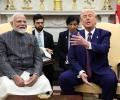
Prime Minister Narendra Modi and US President Donald Trump discussed the West Asia crisis and the importance of keeping the Strait of Hormuz open and secure. They also reviewed progress in bilateral ties and anticipated upcoming deals in the energy sector.
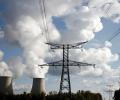
India's brittle energy security is inextricably linked to two opposing paradigms - fossil fuels, and the transition to green energy. The first powers the present; the second paves the way for Viksit Bharat in 2047.
Production growth in India's eight core infrastructure sectors slowed to a three-month low of 2.3 per cent in February, impacted by contractions in crude oil, natural gas, and refinery products output.
